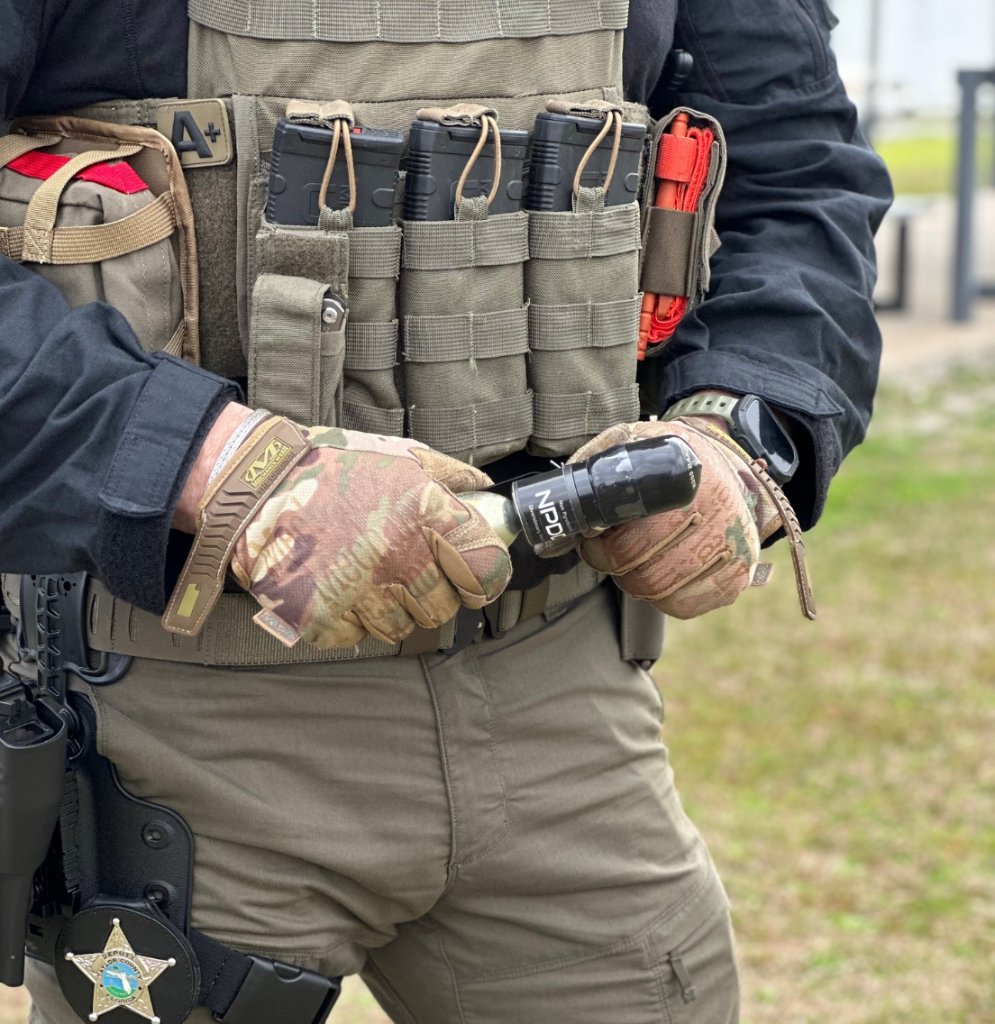
California Senate Bill 937, introduced by Senator Gonzalez on January 29, 2026, would impose a detailed set of restrictions on how and when law enforcement agencies across the state may deploy flash-bang grenades and explosive breaching charges. The bill applies to every law enforcement agency operating within California — no agency is exempt.
The legislation defines flash-bang grenades broadly. According to the bill text, the category covers any less-than-lethal explosive or pyrotechnic device intended to stun, distract, or disperse crowds. That definition explicitly includes blast balls, sting balls, stinger grenades, noise flash diversionary devices, concussion grenades, and stun grenades. The bill also covers devices that emit chemical agents, kinetic energy projectiles, or shrapnel alongside their light and sound effects — a detail that extends its reach well beyond simple noise-and-flash tools.
Prohibited Uses and Hard Limits
SB 937 draws clear lines around when these devices cannot be used. Officers are barred from deploying flash-bang grenades solely because someone has violated an imposed curfew, made a verbal threat, or failed to comply with a law enforcement directive. Those three triggers alone, the bill says, are insufficient justification.
The bill sets a 300-foot buffer zone. Flash-bang grenades may not be deployed within 300 feet of school grounds, parks, or any other area where children are present at the time of use. That distance requirement is specific and applies at the moment of deployment — not based on whether children are normally expected to be present.
The bill also prohibits aiming these devices at a person's head, neck, or other vital organs. That restriction addresses a documented injury pattern associated with direct-fire use of diversionary munitions.
Before any deployment, the bill mandates that de-escalation techniques must have been attempted and failed. Officers are also required to make an objectively reasonable effort to extract individuals in distress before a device is deployed. The bill further requires that officers minimize incidental impact on bystanders, journalists, and medical personnel at the scene.
The use of these devices, according to the bill, must remain consistent with the goal of bringing objectively dangerous and unlawful situations under control safely.
Command Authority and Existing Law
Under SB 937, only a commanding officer physically present at the scene of an assembly, protest, or demonstration may authorize the use of flash-bang grenades. That requirement centralizes the decision at the command level and removes the option for individual officers to deploy on their own authority in crowd situations.
The bill builds on existing California law, which already requires that kinetic energy projectiles and chemical agents be deployed only by officers who have completed specific crowd control training. SB 937 layers additional procedural and geographic requirements on top of that existing framework rather than replacing it.
Legislative Timeline and Next Steps
The bill was first introduced January 29, 2026. The Senate amended it on March 10, 2026, and again on May 14, 2026, according to the bill's legislative record. Following those amendments, the bill was re-referred to the Senate Committee on Appropriations on June 23, 2026, where it now awaits further action.
The Appropriations Committee referral is a standard procedural step for bills with potential fiscal impacts on the state. Because SB 937 would impose new training, documentation, and operational requirements on all California law enforcement agencies, cost considerations are likely central to that committee's review. No hearing date before Appropriations has been identified in the available bill record.
If passed, the bill would affect every sworn law enforcement agency in California — city police departments, county sheriff's offices, transit police, university police, and any other state-authorized law enforcement body. The breadth of that coverage means departments of vastly different sizes and operational profiles would all need to review their policies, training curricula, and use-of-force documentation procedures to ensure compliance.
The bill's specific numerical thresholds — the 300-foot buffer, the requirement that de-escalation be attempted before deployment — give agencies concrete benchmarks to write into policy, but they also create clear evidentiary standards that could be tested in civil litigation following any deployment that results in injury.
Senator Gonzalez introduced the measure amid ongoing legislative attention to crowd control practices in California. The bill's language reflects a pattern seen in other California use-of-force legislation: establishing categorical prohibitions, assigning command-level accountability, and requiring documented procedural steps before force is authorized.