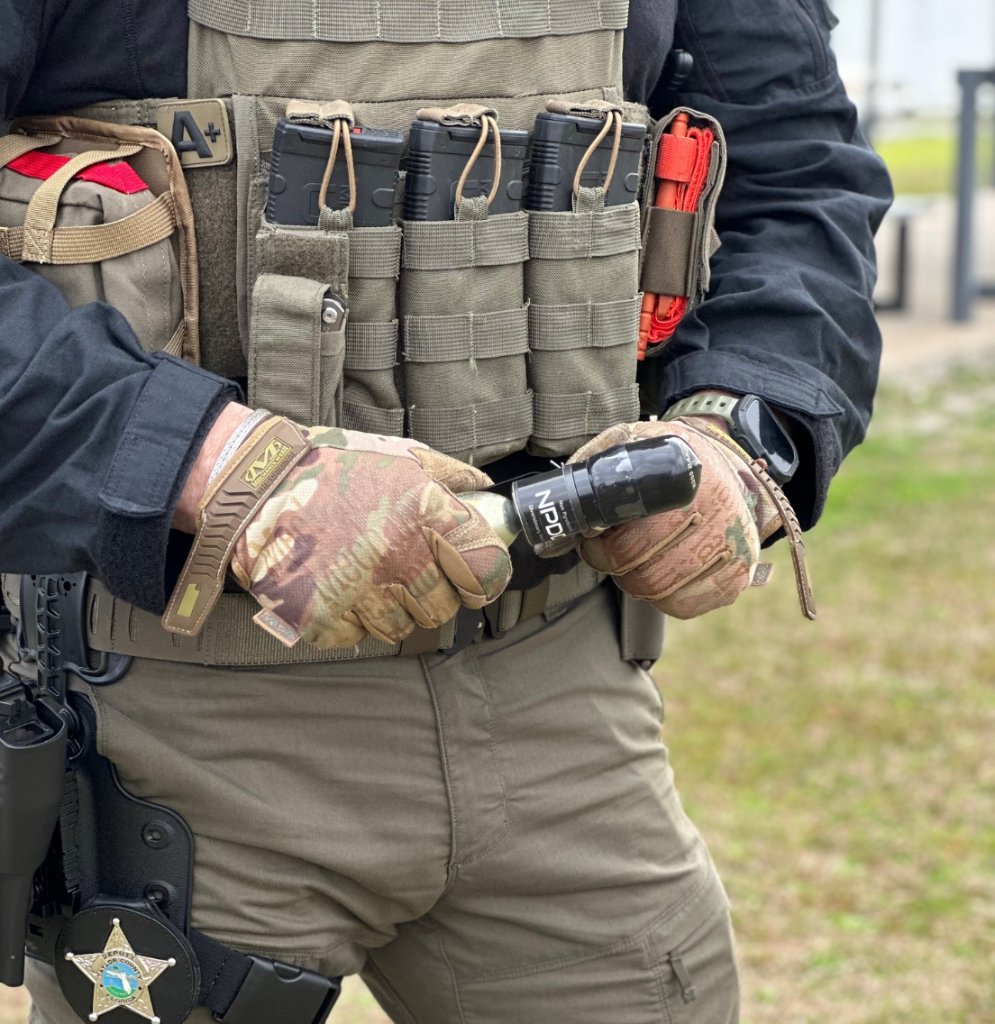
California Senator Lena Gonzalez has introduced Senate Bill 937, legislation that would place new statewide limits on how law enforcement agencies acquire, deploy, and report the use of flash-bang grenades — devices the bill's fact sheet describes as explosive pyrotechnic tools originally developed for military use that produce a blinding flash of light, a sudden loud noise, and a concussive blast.
What the Bill Covers and How It Defines These Devices
SB 937 casts a wide definitional net. Under the bill's language, the term "flash-bang grenade" encompasses stun grenades, concussion grenades, noise flash diversionary devices, blast-balls, sting balls, and stinger grenades, according to the bill text. The devices may be deployed by hand or as projectiles, the fact sheet notes. That breadth matters operationally: agencies that have categorized certain devices differently from traditional flash-bangs would likely find them covered under the proposed statute.
Proponents of the bill argue that existing California law already restricts the use of tear gas and kinetic energy projectiles, but that flash-bangs have so far escaped comparable statewide safety and training mandates, according to the bill's fact sheet. SB 937 is framed as closing that gap.
The Immigration Enforcement Prohibition
One of the bill's most direct provisions is a flat prohibition. SB 937 would bar any federal, state, or local law enforcement agency from using flash-bang grenades for the purpose of immigration enforcement, according to the bill text. The prohibition extends to explosive breaching charges as well, the bill provides. The restriction applies across agency types — it is not limited to state or local departments but reaches federal agencies operating within the state's regulatory reach.
No carve-outs or emergency exceptions for immigration-related operations are identified in the available bill language or fact sheet.
Authorization, Safety Standards, and Reporting Requirements
Outside the immigration context, SB 937 does not prohibit flash-bang use outright, but it layers in procedural controls. Only a commanding officer physically present at the scene may authorize deployment, under the bill's terms. That requirement shifts decision-making authority away from individual officers and anchors it to a specific supervisory role at the incident level.
For deployments involving the dispersal of assemblies or protests, the legislation requires agencies to follow specific safety standards, though the bill's available materials do not detail every technical parameter. The aim, according to the fact sheet, is to increase accountability for use of force in crowd control and tactical scenarios.
Public reporting is also mandatory under SB 937. Every time an agency deploys a flash-bang grenade, the bill requires comprehensive and transparent public disclosure, according to the bill text. The legislation frames this as a state-mandated local program, imposing new administrative duties and reporting protocols on local law enforcement agencies specifically.
That classification has budgetary significance. When California designates a bill as a state-mandated local program, it triggers constitutional provisions that may require the state to reimburse local agencies for the cost of compliance. Agencies tracking SB 937 should monitor whether a fiscal analysis addresses reimbursement obligations.
Legislative Timeline and Where the Bill Stands
SB 937 was introduced by Senator Gonzalez during the 2025–2026 regular session and has gone through multiple amendments across that period, according to legislative records. The most recent amendment came on August 13, 2026, when the bill was amended in the Assembly and ordered to a third reading, according to the California MyRepTracker record. As of late September 2026, the bill remained under active consideration in the California legislature.
A third-reading order in the Assembly means the bill is positioned for a floor vote in that chamber. If it passes the Assembly, it would return to the Senate for concurrence on Assembly amendments before heading to the Governor.
Relationship to Assembly Bill 481
SB 937 does not operate in isolation. Existing California law under Assembly Bill 481 already requires agencies to publish specific policies governing the acquisition and use of military equipment, according to the bill's fact sheet. Flash-bang grenades, as devices with military origins, fall within that framework. SB 937 would add a layer of use-specific restrictions and real-time reporting obligations on top of the acquisition and policy publication rules AB 481 established.
For agencies that have already built AB 481 compliance programs, SB 937 represents an operational expansion of those obligations — not a replacement. Departments would need to update use-of-force policies, establish commanding-officer authorization protocols, and build reporting pipelines that satisfy the new public disclosure requirement if the bill becomes law.
Agencies with flash-bang devices in their inventories should track the bill's floor vote and any final amendments closely.