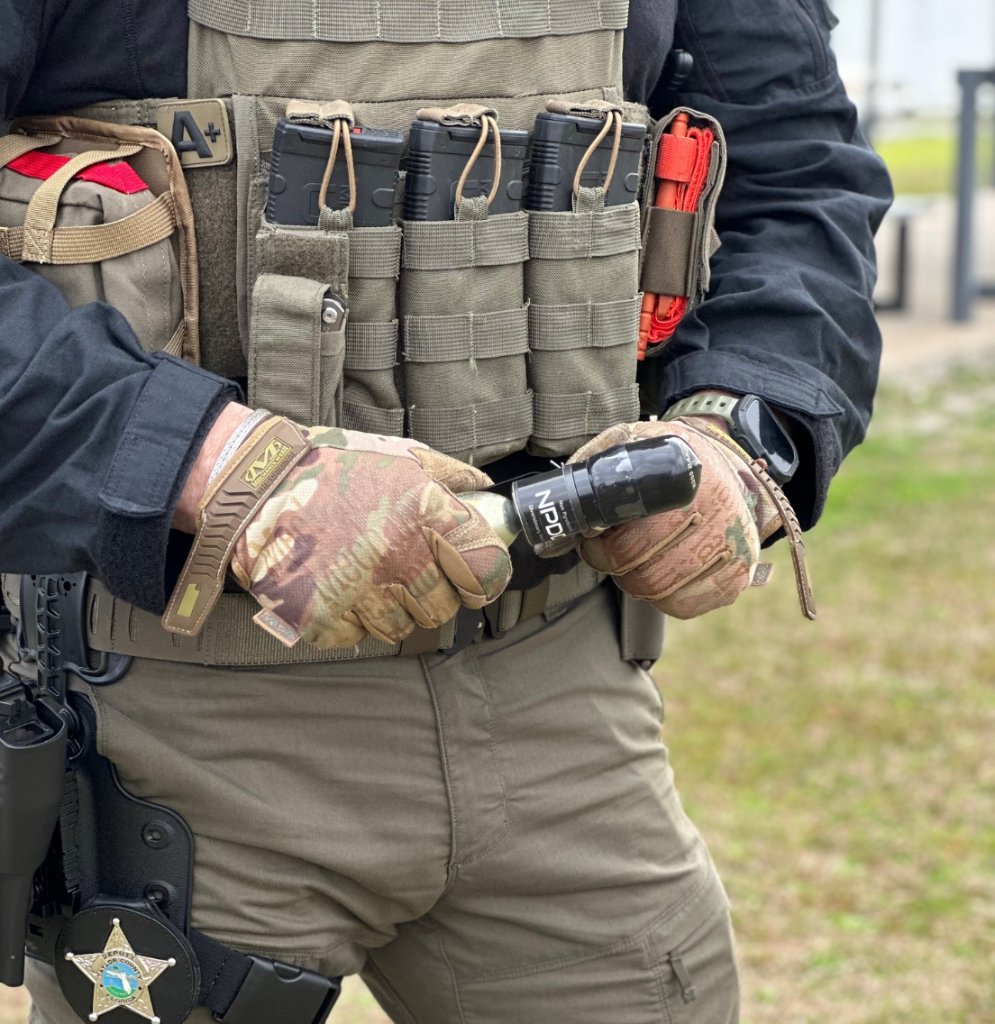
California Senate Bill 937, filed in the 2025-2026 legislative session, proposes direct restrictions on law enforcement use of flash-bang grenades and explosive breaching charges statewide. The bill's clearest line is an explicit prohibition: no law enforcement agency in California may deploy flash-bang grenades for immigration enforcement purposes. That ban is not qualified or conditional. It applies regardless of agency size, jurisdiction, or operational context.
The bill defines 'flash-bang grenades' to include blast balls, sting balls, stinger grenades, noise flash diversionary devices, concussion grenades, and stun grenades. The definition covers any less-than-lethal explosive or pyrotechnic device deployed by hand or as a projectile that is intended to stun, distract, or disperse crowds. Devices that emit chemical agents, kinetic energy projectiles, or shrapnel — in addition to light and sound — fall within scope. That language is significant. It means devices historically categorized as less-than-lethal are now grouped with tools that can cause direct physical impact.
Existing California law already places restrictions on the use of kinetic energy projectiles and chemical agents when dispersing assemblies, protests, or demonstrations. SB 937 layers onto that framework rather than replacing it.
How Agencies Can Respond Under the Bill
The proposed legislation does not set a ceiling on restrictions. According to the bill, nothing in SB 937 prevents individual law enforcement agencies from adopting policies more stringent than what the state mandates. An agency can prohibit flash-bang use entirely, restrict it to specific warrant service scenarios, or require supervisory sign-off — all of that remains permissible under the proposed state framework.
What agencies cannot do, if the bill passes, is use these devices in connection with immigration enforcement operations. That specific prohibition has no carve-out for exigent circumstances or federal coordination.
South Pasadena's Inventory as a Baseline Example
The South Pasadena Police Department's 2024-2025 Military Equipment Use Report documents what a small California agency currently holds in this category. According to the report, the department maintains an inventory of flash-bang diversionary devices. The report lists flash-bang canisters at approximately $50.00 per unit and flash-bang rounds at approximately $18.00 per round.
Those figures illustrate the low per-unit cost of maintaining pyrotechnic diversionary tools. For agencies now evaluating whether to continue carrying these devices or transition to alternatives, the acquisition cost is a minor variable compared to training requirements, liability exposure, and the policy changes SB 937 would impose.
The Push Toward Non-Pyrotechnic Alternatives
Apart from the legislative process, a separate shift is underway in how some agencies approach diversionary devices at a hardware level. Non-pyrotechnic alternatives have been marketed as tools that remove fire and fragmentation risk from tactical deployments. One such device claims to produce more than 175 decibels of audio output without pyrotechnic components. Another non-reloadable, single-use device is documented to produce 162 decibels of sound output measured at five feet.
Digital fuse technology has also emerged as a proposed improvement over traditional pyrotechnic designs, with proponents citing enhanced safety margins, adjustable timing, and expanded tactical options compared to conventional devices.
The move toward non-pyrotechnic tools is being driven, according to industry and agency documentation, by efforts to reduce liability and improve safety during tactical operations — not by SB 937 directly. The bill does not mandate any specific technology or require agencies to acquire non-pyrotechnic alternatives. But its definitional scope, which hinges on function rather than construction, raises questions about whether some non-pyrotechnic devices would fall under its framework depending on what agents they emit or what projectiles they deploy.
Procedural Status and What Comes Next
SB 937 is a product of the current 2025-2026 California legislative session. The bill has not yet been enacted. Before it could take effect, it would need to clear committee review, floor votes in both chambers of the California Legislature, and gubernatorial signature.
The bill's introduction reflects, according to the legislative record, broader concerns about the use of explosive-based diversionary devices in public order and crowd management situations. How it moves through the legislature — and whether its immigration enforcement prohibition survives amendment — will determine the operational reality for California agencies that currently carry these devices.
For agencies like South Pasadena, which document flash-bang inventory as part of annual military equipment reporting under existing California law, SB 937 would add a new compliance layer on top of reporting requirements already in place. The bill does not appear to alter the existing reporting framework, but agencies tracking their equipment use policies will need to monitor its progress closely as the session advances.