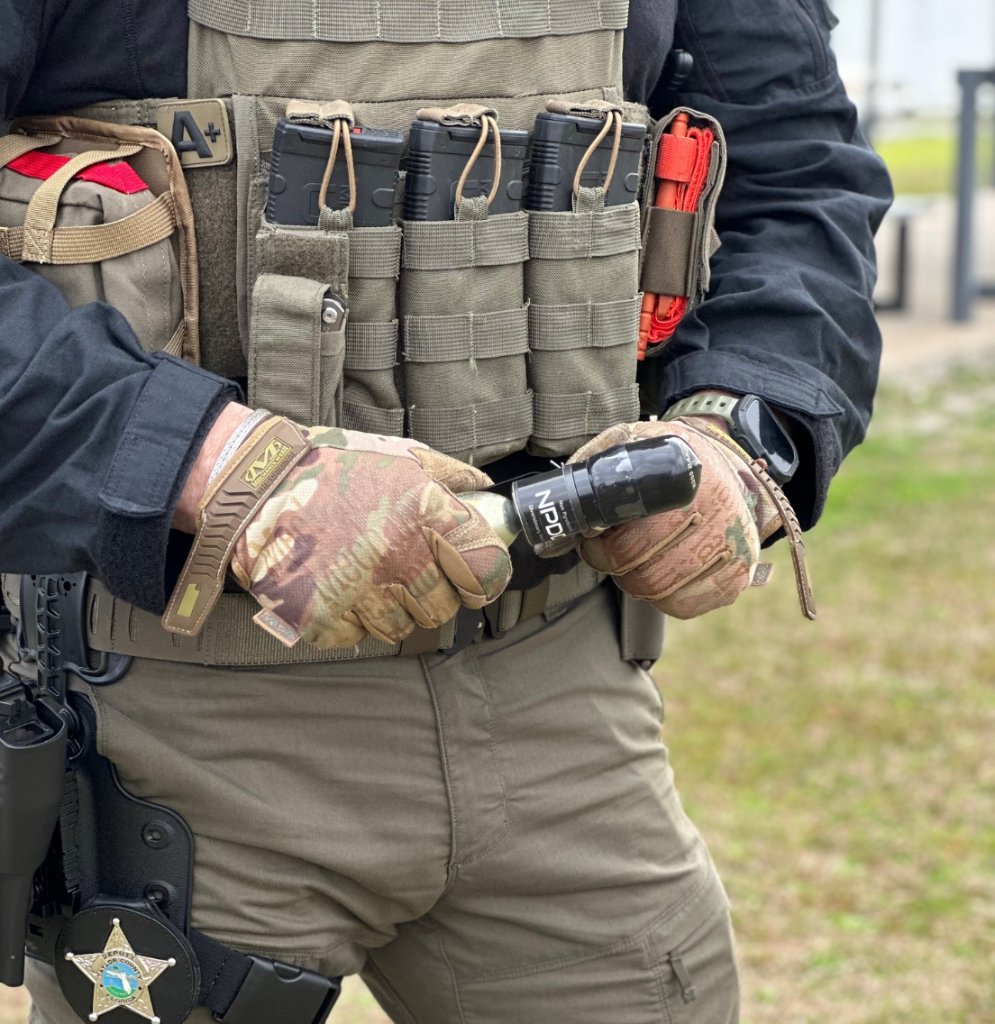
California Senate Bill 937 was chaptered on August 28, 2026, amending Penal Code Section 13652. The law directly addresses how flash-bang grenades and explosive breaching charges are defined under state statute. The definition is specific: flash-bang grenades cover any less-than-lethal explosive or pyrotechnic device intended to stun, distract, effect an arrest, or disperse a gathering. The statute then names the devices explicitly — blast balls, sting balls, stinger grenades, noise flash diversionary devices, concussion grenades, and stun grenades all fall within scope. That list matters. Agencies that previously categorized some of these tools differently now have a statutory anchor for classification.
California law, as reflected in agency policy updates, requires that sworn personnel use diversionary devices only for official law enforcement purposes and in line with state and federal use-of-force standards. Deployment is generally restricted to high-risk incidents: hostage rescues, barricaded subject situations, and high-risk warrant services. Annual training specific to diversionary device deployment is now a standard requirement at many agencies.
Sacramento PD Revises General Order 410.06
The Sacramento Police Department updated General Order 410.06 on November 18, 2026, to bring the policy into alignment with current military equipment reporting requirements. The revised order covers the department's inventory, which includes 40mm warning and signaling munitions designed to emit a 170-decibel sound and bright light. Sacramento's update came roughly three months after SB-937 was chaptered, reflecting the procedural lag common when departments reconcile existing general orders with new statutory language.
The department did not revise the order in isolation. Military equipment reporting under California law follows a structured annual cycle, and General Order 410.06 governs how Sacramento tracks, reports, and accounts for equipment that meets the statutory definition of military equipment.
How Other Agencies Are Responding
Alhambra Police Department revised Policy 706 on June 2, 2026 — before SB-937 was chaptered — classifying noise-flash diversionary devices as military equipment subject to specific acquisition and reporting protocols. The department uses a non-bursting, non-fragmenting single-use diversionary device. That design characteristic is relevant to the broader shift in how agencies are sourcing diversionary tools: non-pyrotechnic diversionary devices, commonly called NPDDs, are increasingly marketed as alternatives to traditional flash-bangs, with manufacturers citing reduced fire risk, reduced heat, and no toxic smoke inhalation as distinguishing features.
The Santa Clara County Sheriff's Office uses an electronic diversionary device initiated by a fuel-air event rather than deflagration. The Sheriff's Office reported costs as of June 2026: $110 per initiator and $58 per reload. The electronic system is noted for minimal fire risk and no fragmentation potential compared to traditional pyrotechnic models. That cost structure — a reusable initiator with a per-use reload — differs from single-use pyrotechnic grenades and has procurement implications for agencies managing military equipment budgets under annual reporting requirements.
The El Centro Police Department submitted its 2026 Annual Military Equipment Report on September 30, 2026, in compliance with Government Code section 7072. El Centro's inventory includes reloadable diversionary devices at an initial cost of $55.00 per unit. That figure is on the lower end of costs reported by California agencies for comparable equipment.
One separate agency — the Leon County Sheriff's Office, operating under a policy effective April 3, 2017 — requires that the serial numbers of all deployed diversionary devices be documented following any use. That requirement creates a direct audit trail tying specific devices to specific incidents, a practice that may become more common as reporting standards tighten.
Non-Pyrotechnic Devices and the Procurement Shift
The growing market for non-pyrotechnic diversionary devices reflects concerns that conventional flash-bangs carry risks — fire, heat injury, toxic smoke — that some incident environments make unacceptable. At least one NPDD on the market features interchangeable burst caps, allowing operators to adjust acoustic impulse and concussive force depending on the tactical situation, according to available product documentation.
SB-937's expanded statutory definition does not carve out NPDDs. The definition turns on function — stunning, distracting, effecting arrest, dispersing — not on the ignition mechanism. An electronic fuel-air device that stuns occupants during a barricaded subject situation falls within the same regulatory category as a traditional pyrotechnic concussion grenade under the new statutory language. Agencies sourcing NPDDs as alternatives will still need to inventory, report, and train on those devices under the same military equipment framework.
Annual training requirements are now standard at many agencies for SWAT operators who deploy diversionary devices. That training mandate runs alongside the reporting cycle, meaning departments are managing both an annual documentation obligation and an annual qualification requirement for personnel authorized to deploy these tools. The combination creates an administrative and operational rhythm that departments will need to plan for explicitly in the years following SB-937's implementation.