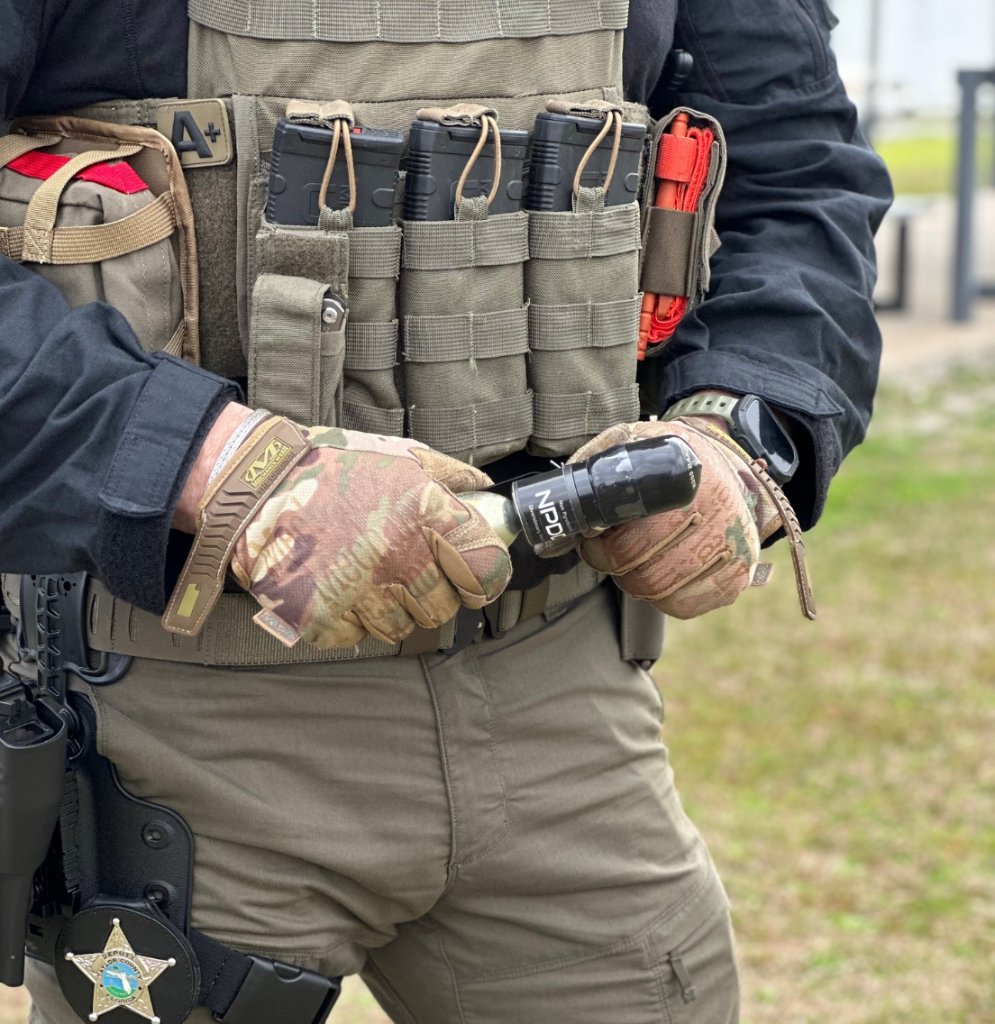
California Senate Bill 937 was chaptered on August 28, 2026, amending Penal Code Section 13652. The bill targets a narrow but operationally significant category of equipment: flash-bang grenades and explosive breaching charges. Agencies that field either type are now working through updated general orders, annual reports, and procurement reviews to meet what the statute spells out in precise language.
What SB-937 Actually Says
The legislation defines flash-bang grenades as any less-than-lethal explosive or pyrotechnic devices intended to stun, distract, effect an arrest, or disperse a gathering. The definition is not vague. SB-937 explicitly names blast balls, sting balls, stinger grenades, noise flash diversionary devices, concussion grenades, and stun grenades as covered items. That list matters for procurement: if a device appears on it, the acquiring agency must follow the acquisition and reporting protocols attached to the military equipment statute. Departments that previously categorized some of these tools differently from "flash-bangs" no longer have that flexibility.
California law requires sworn personnel to use diversionary devices only for official law enforcement purposes and in accordance with state and federal use-of-force standards. Deployment is generally restricted to high-risk incidents — hostage rescues, barricaded subject situations, or high-risk warrant services — and many agencies now require SWAT operators to complete annual training specifically focused on diversionary device deployment.
Sacramento Updates General Order 410.06
The Sacramento Police Department revised General Order 410.06 on November 18, 2026, aligning the order with current military equipment reporting requirements. The department's inventory includes 40mm warning and signaling munitions designed to emit a 170-decibel sound and bright light. Sacramento did not reclassify those munitions out of compliance review; the November update brought the department's documentation framework in line with what state law now requires agencies to track and report annually.
The timing — nearly three months after SB-937 was chaptered — is consistent with the administrative cycle most departments follow when a new statute affects existing general orders. Policy drafting, supervisory review, and command approval all take time, and November 18 reflects that process playing out in a large municipal department.
El Centro and Alhambra File Under the New Framework
El Centro Police Department submitted its 2026 Annual Military Equipment Report on September 30, 2026, in compliance with Government Code section 7072. The department's inventory includes reloadable diversionary devices at an initial cost of $55.00 per unit. That figure is notable because reloadable systems carry a different long-term cost profile than single-use devices — a distinction that matters when agencies calculate budget requests and justify acquisitions in public annual reports.
Alhambra Police Department revised Policy 706 on June 2, 2026, classifying noise-flash diversionary devices as military equipment subject to specific acquisition and reporting protocols. The department fields a non-bursting, non-fragmenting single-use diversionary device. That design characteristic — no fragmentation, no burst — reduces certain injury risks associated with deployment in confined spaces, according to the department's policy documentation.
Santa Clara County and the Non-Pyrotechnic Option
Santa Clara County Sheriff's Office takes a different equipment approach. The agency fields an electronic diversionary device initiated by a fuel-air event rather than deflagration. The device is described in county documentation as carrying minimal fire risk and no fragmentation potential compared to traditional pyrotechnic models. As of June 2026, the Sheriff's Office reported a cost of $110 per initiator and $58 per reload.
That cost structure — a reusable initiator with replaceable reload components — is part of a broader product category that manufacturers market as non-pyrotechnic diversionary devices, or NPDDs. These tools are positioned as alternatives to traditional flash-bangs, with the stated goal of reducing risks associated with fire, heat, and toxic smoke inhalation. At least one NPDD on the market features interchangeable burst caps that allow operators to adjust acoustic impulse and concussive force depending on the operational environment.
The Santa Clara numbers put the economics in concrete terms. An agency deploying the electronic system pays $110 for an initiator it can use repeatedly, then $58 each time it needs a reload. By contrast, El Centro's $55-per-unit reloadable device sits at roughly half the reload cost, though the two systems are not directly comparable without knowing initiator lifespan and training consumption rates.
Documentation Requirements Persist Regardless of Device Type
One compliance constant runs across device types: post-deployment documentation. Some agencies, including one with a policy effective April 3, 2017, require that the serial numbers of all deployed diversionary devices be recorded following use. That requirement predates SB-937 by nearly a decade and shows that serial-number tracking has been a recognized accountability measure long before the 2026 amendments.
SB-937 does not eliminate that kind of agency-level requirement. It layers statutory definitions and reporting obligations on top of existing departmental policy. Agencies still set their own internal deployment thresholds, training minimums, and documentation formats — but the devices those policies govern now carry a clearer statutory identity under California law than they did before August 28, 2026.