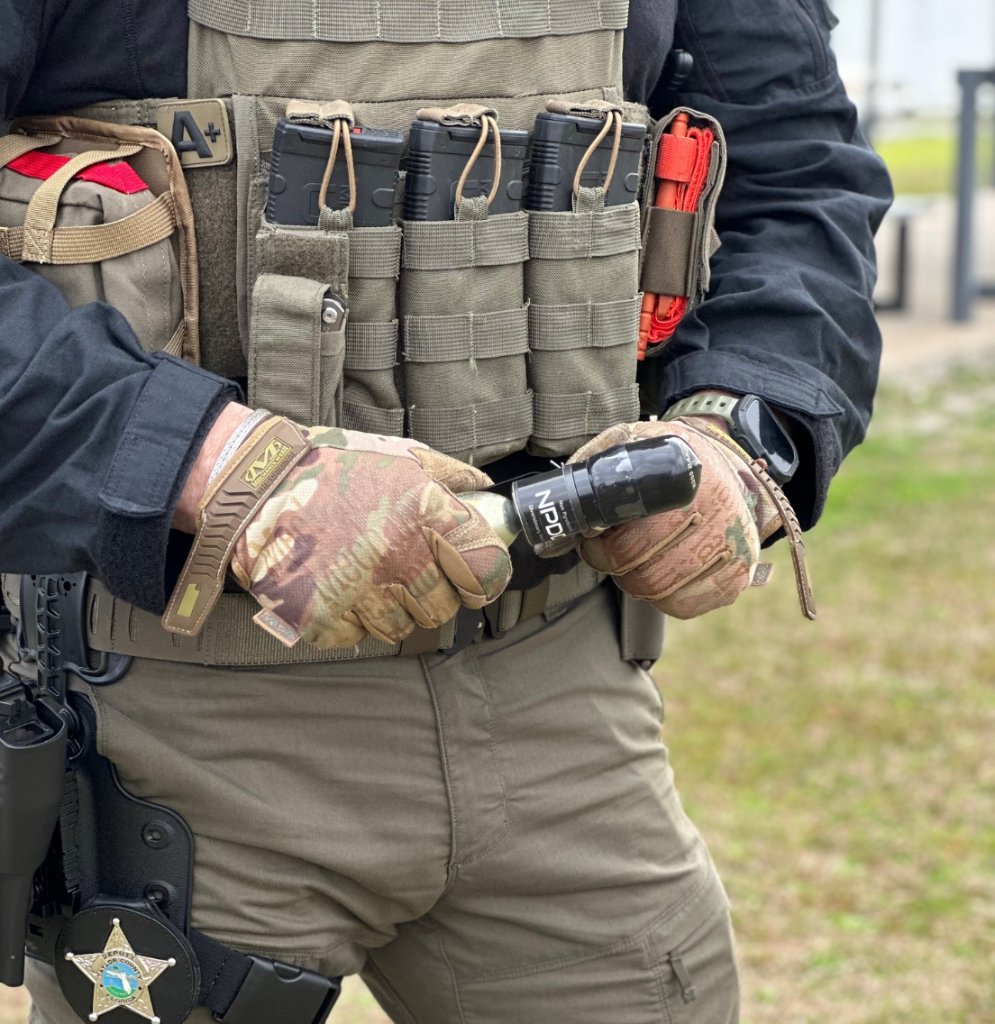
Governor Gavin Newsom signed Senate Bill 937 into law on September 29, 2026. The bill, authored by Senator Lena Gonzalez (D-Long Beach), places new restrictions on how California state and local law enforcement agencies may use diversionary devices — commonly known as flash-bangs. It does not ban possession of the devices outright. It restricts their application in two specific operational contexts: crowd control at protests and demonstrations, and immigration enforcement operations.
On the immigration enforcement side, the prohibition is categorical. Under SB 937, law enforcement agencies operating in California may not deploy diversionary devices or explosive breaching charges during immigration enforcement operations. That language was prompted directly by an incident in Huntington Park, where federal agents used an explosive breaching charge on a residence occupied by a mother and two children, according to the bill's legislative record.
For crowd control scenarios, the bill does not prohibit use outright but aligns diversionary devices with the existing regulatory framework already governing other less-lethal weapons under California law. Any deployment now triggers a mandatory documentation requirement.
The Incident Record Behind the Bill
Two specific incidents drove the legislation, according to its sponsors.
The first was a 2025 protest in Los Angeles. A bystander was struck by a diversionary device and suffered a finger amputation as a result. That incident drew attention to the absence of any reporting or accountability mechanism specific to flash-bang use.
The second was the Huntington Park operation. Federal agents deployed an explosive breaching charge at a home. A mother and two children were inside. The bill's authors cited that event as evidence that explosive entry tools were being used in residential immigration enforcement with no state-level restrictions in place.
Senator Gonzalez and community advocacy groups supporting police accountability pushed both incidents as the factual basis for expanding California's less-lethal weapon regulations to cover these specific devices and scenarios.
Reporting Requirements and the DOJ Database
Starting January 1, 2027, every deployment of a diversionary device by a California law enforcement agency must be documented in the California Department of Justice's public use-of-force database. The California DOJ will manage that database. The requirement applies to state and local agencies alike.
The documentation mandate is designed to create public oversight of force incidents involving these devices. Before SB 937, there was no statewide mechanism that required agencies to report flash-bang use or submit that data to any centralized public record. The new law closes that gap by treating diversionary device deployments the same way other use-of-force incidents are tracked under existing California reporting structures.
Shayna Englin, Vice President of Policy and Advocacy for the California Community Foundation, said the law establishes common-sense rules for the use of these devices. The bill's proponents have framed it as a civil rights and public safety measure, aimed at increasing transparency across all agencies operating within the state.
Compliance Deadlines and What Agencies Must Do Next
The effective date is January 1, 2027. Senator Gonzalez's office noted that the gap between the signing date and the effective date is intended to give agencies time to update internal policies, revise use-of-force protocols, and adjust training programs to reflect the new legal requirements.
For agencies that currently have diversionary devices in their inventory and authorized in their use-of-force policies, the practical compliance tasks are concrete. Policies governing protest response will need to be updated to reflect the new alignment with less-lethal weapon regulations. Any policy permitting use of explosive breaching charges during immigration enforcement operations will need to be revised or rescinded. And reporting workflows will need to be built or modified so that any qualifying deployment flows into the California DOJ's public database on the date of incident.
The law passed the California legislature before Newsom signed it on September 29, 2026. Community advocacy organizations focused on police accountability supported the bill through its legislative process. The legislation specifically addresses the use of military-style equipment in protest and immigration enforcement contexts, according to Senator Gonzalez's office.