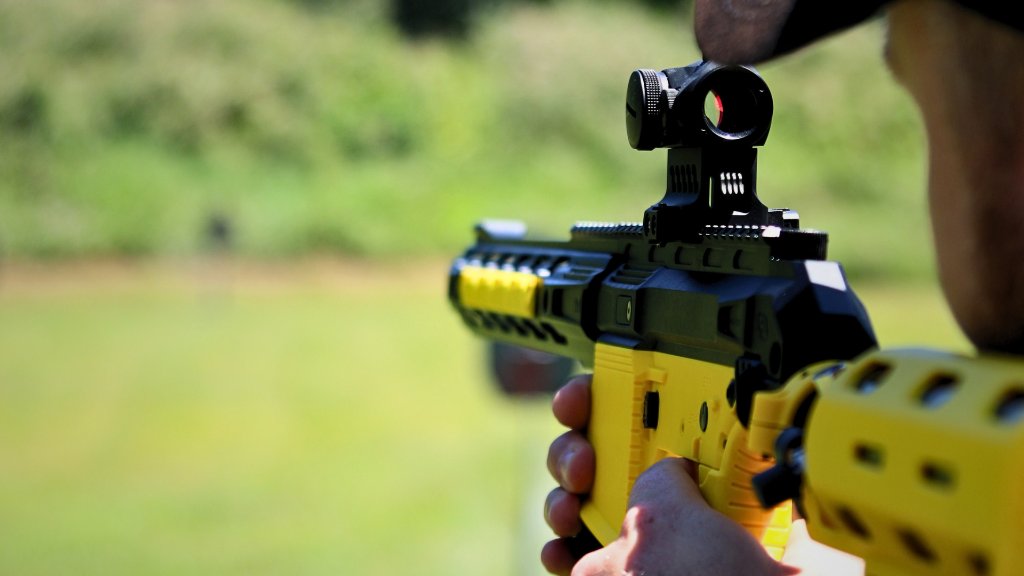
U.S. Customs and Border Protection amended its Request for Quote for Less Lethal Pressurized Air Launcher Systems (LLPALS), according to a notice published November 3, 2026, on SAM.gov under Notice ID 70B06C25Q00000073. The amendment targets one specific element of the Statement of Work: the required concentration of PAVA powder in projectiles. That concentration was raised from 0.5% (±0.03%) to 2.0% (±0.03%). Every other term, condition, and technical requirement in the original solicitation stays in place, the notice states.
The CBP Mission Support Contracting Division, which manages the solicitation, issued the change directly in response to Question #4 submitted by a prospective quoter during the inquiry period. The amendment instructs all quoters to disregard the original SOW entirely and use only the amended version attached to the November 3 notice. That instruction carries procedural weight: any quote prepared against the old specification would not conform to the current requirement.
The procurement is intended to support the CBP Law Enforcement Safety & Compliance Directorate, according to the solicitation record.
What PAVA Is and Why Concentration Matters
PAVA — Pelargonic Acid Vanillylamide — is a synthetic organic compound used in less-lethal munitions, according to the solicitation documentation. It mimics the physiological effects of capsaicin. In projectile form, PAVA causes chemical irritation on contact and combines that effect with kinetic impact to achieve subject compliance.
The fourfold increase in required concentration — from 0.5% to 2.0% — represents a material change in the chemical payload of each round. The College of Policing has stated that significant changes to less-lethal weapon systems should be evaluated to balance effectiveness against the minimization of injury risk. That principle applies directly here: a higher PAVA concentration may produce faster or more reliable incapacitation but also warrants scrutiny of the physiological effects on subjects, particularly in extended or repeat exposures.
The ±0.03% tolerance band is unchanged, meaning the precision standard for manufacturing compliance remains the same even as the target concentration quadruples.
How Less Lethal Launchers Fit Into Agency Operations
Less-lethal launchers are used by law enforcement for control of combative or non-compliant subjects, according to established operational guidance. PAVA-based projectiles are a recognized method within that category, combining kinetic impact with chemical irritation.
Agency policies vary. The Little Rock Police Department defines use of a less-lethal launcher as a reportable use of force, meaning each deployment triggers documentation and review under that department's procedures. The Brea Police Department requires that operators receive training from POST-certified instructors before they are authorized to deploy less-lethal launchers. Standard operating procedures in the field commonly distinguish between two deployment modes: direct impact, aimed at a specific subject, and area saturation, intended to affect a broader space or crowd.
CBP's procurement process requires adherence to specific safety and compliance standards for all less-lethal equipment, according to the solicitation. The Law Enforcement Safety & Compliance Directorate's involvement signals that any equipment acquired under this RFQ will be subject to those internal standards before and after fielding.
Procurement Context and Next Steps
The ATF issued Ruling 2026-2 earlier this year, classifying certain remote-restraint devices as non-firearms. That ruling has the potential to affect procurement cycles for non-lethal tools across federal agencies, as the regulatory category of a device can determine which acquisition pathways and testing requirements apply.
For this specific solicitation, the path forward is straightforward, according to the amendment notice. Quoters must base their submissions on the amended SOW. The CBP Mission Support Contracting Division has not, in this amendment, altered deadlines, evaluation criteria, or any other term. The amendment is a targeted technical correction driven by a vendor's direct question about the original specification.
The concentration change from 0.5% to 2.0% is the single operative fact for vendors preparing quotes. Getting that number wrong — or quoting against the superseded document — would result in a non-conforming submission. The November 3, 2026, notice on SAM.gov is the controlling document.