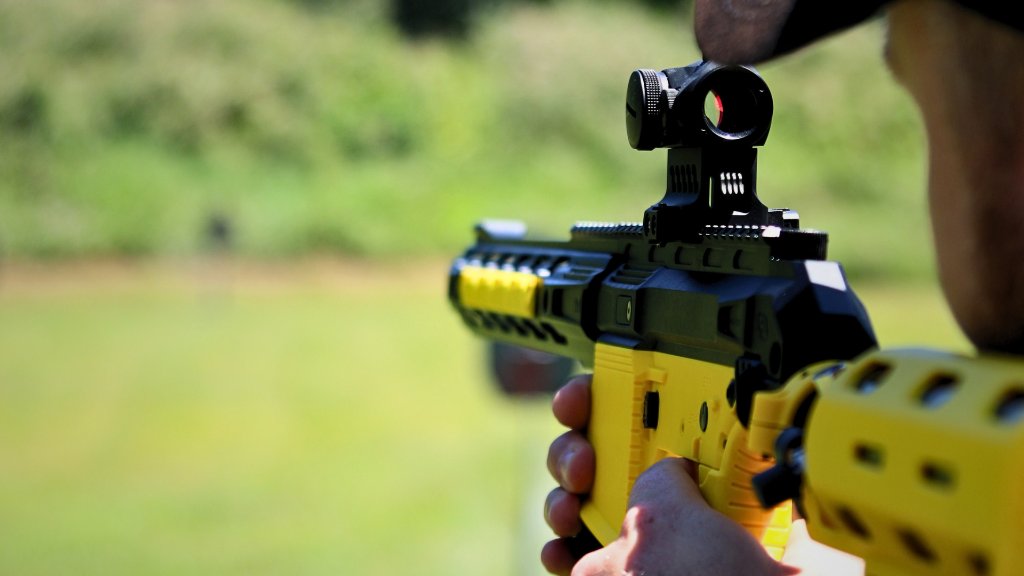
U.S. Customs and Border Protection has amended its solicitation for Less Lethal Pressurized Air Launcher Systems, nearly quadrupling the required concentration of PAVA powder in projectiles. The amendment, published November 3, 2026, on SAM.gov under Notice ID 70B06C25Q00000073, modifies the Statement of Work and instructs all quoters to disregard the original version entirely.
What the Amendment Actually Changes
The single substantive modification concerns PAVA powder concentration. Under the original solicitation, projectiles were required to contain PAVA at 0.5% (±0.03%). The amended Statement of Work sets that figure at 2.0% (±0.03%), according to the SAM.gov notice. The tolerance band stays the same; the target concentration does not. Every other term, condition, and technical requirement from the original solicitation remains in force without modification, the amendment states.
PAVA — Pelargonic Acid Vanillylamide — is a synthetic organic compound that mimics the effects of capsaicin, the active irritant in pepper-based agents. It is used in less-lethal munitions to achieve compliance through a combination of kinetic impact and chemical irritation. The compound's synthetic origin allows for more consistent concentration levels than plant-derived alternatives, which is relevant to the precision the tolerance band implies.
Why the Change Was Made
CBP made the amendment in direct response to Question #4, a specific inquiry submitted by a prospective quoter regarding the original solicitation requirements, according to the notice. The government reviewed that question and determined a modification to the Statement of Work was warranted. The notice does not describe the content of Question #4 beyond identifying it as the trigger for the change.
The solicitation is managed by CBP's Mission Support Contracting Division. The procurement is intended to support the CBP Law Enforcement Safety & Compliance Directorate, which sets the operational context for the equipment. The directorate's name signals that the systems are subject to both mission-effectiveness and compliance review before fielding.
Procedural Posture for Quoters
The amendment is unambiguous in its instruction: quoters must set aside the original SOW and work from the amended version attached to the November 3, 2026, notice. That directive matters for vendors who had already begun preparing technical responses based on the 0.5% specification. Any quote submitted against the old concentration figure would be non-conforming under the revised requirements.
All other deadlines, pricing structures, and technical requirements carry over unchanged, according to the solicitation record. The amendment does not introduce new evaluation criteria or alter the competitive structure of the acquisition.
How Other Agencies Have Approached Comparable Questions
The question of what concentration is appropriate for PAVA-based projectiles sits inside a broader set of policy decisions law enforcement agencies make about less-lethal systems. The College of Policing has stated that significant changes to less-lethal weapon systems should be evaluated to balance effectiveness with the minimization of injury risk — a standard that applies directly to a fourfold increase in chemical agent concentration.
Agency-level policies reflect that balancing act in different ways. The Little Rock Police Department defines the use of less-lethal launchers as a reportable use of force, creating an accountability record for each deployment. The Brea Police Department requires that operators of less-lethal launchers receive training from POST-certified instructors before being authorized to carry the systems. Standard operating procedures across the field commonly distinguish between direct impact deployment — where a projectile strikes a subject — and area saturation, where chemical dispersal is the primary mechanism. A higher PAVA concentration would affect the calculus for both methods.
Less-lethal launchers are used by law enforcement for the control of combative or non-compliant subjects, and PAVA-based projectile deployment is a recognized method within that context. The CBP procurement process requires adherence to specific safety and compliance standards for all less-lethal equipment, according to the solicitation record, which means the increased concentration will need to meet those internal benchmarks before equipment is accepted.
Separately, the ATF issued Ruling 2026-2, which classified certain remote-restraint devices as non-firearms. That ruling has the potential to affect procurement cycles for non-lethal tools more broadly, though the CBP amendment addresses a pressurized air system already outside firearm classification.
The SAM.gov notice is the controlling document for vendors responding to this solicitation. CBP has not published additional guidance beyond the amendment itself.