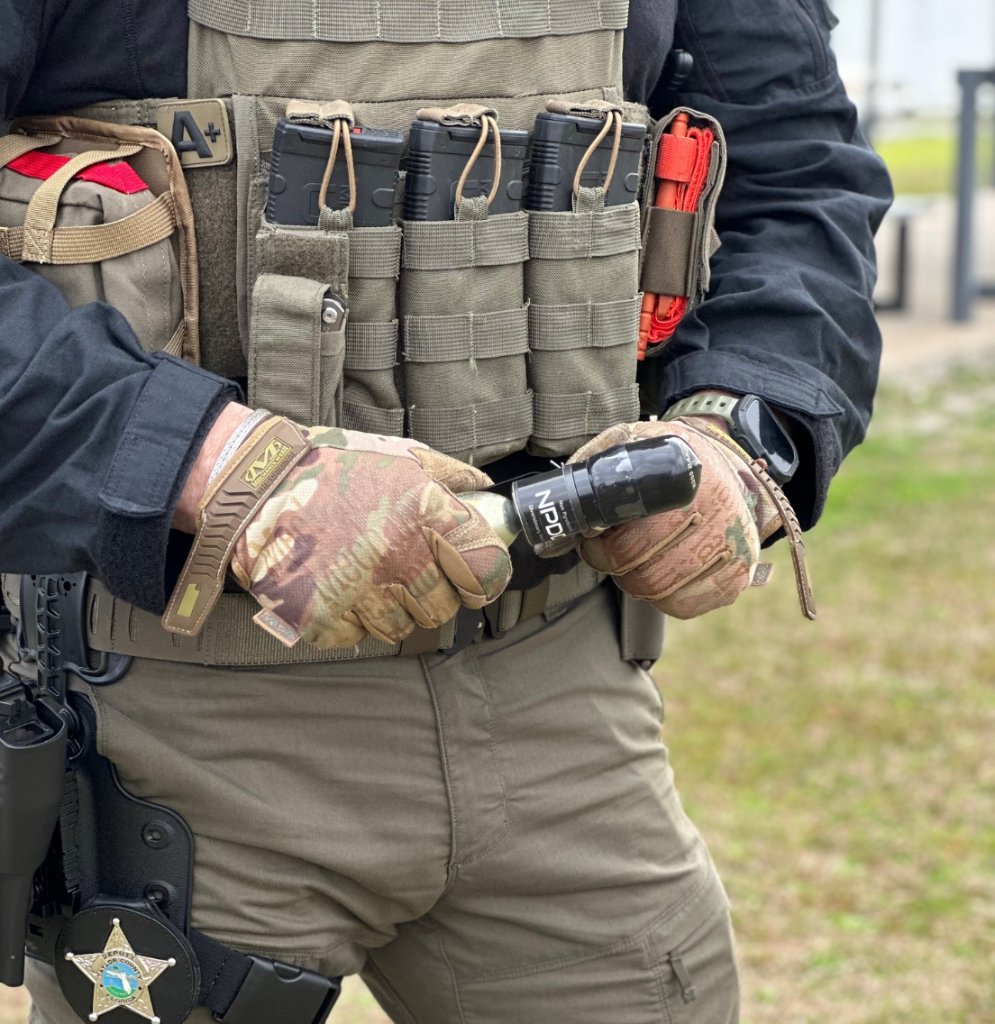
California Senate Bill 937 draws a hard line on one specific use of flash-bang grenades: the bill explicitly prohibits their deployment for immigration enforcement purposes, according to the legislative text. That prohibition is among the most concrete provisions in the bill, which otherwise layers new regulatory language on top of existing California restrictions covering crowd-control tools.
What the Bill Defines and Covers
SB 937 defines flash-bang grenades as less-than-lethal explosive or pyrotechnic devices intended to stun, distract, or disperse crowds, according to the bill's text. The definition is not narrow. It covers blast balls, sting balls, stinger grenades, and noise flash diversionary devices—a range of tools that agencies across the state currently carry in their less-lethal inventories.
Existing California law already restricts the use of kinetic energy projectiles and chemical agents for crowd dispersal. SB 937 extends that regulatory framework to the flash-bang category specifically. The bill also makes clear that agencies are not prevented from adopting policies more stringent than those the state mandates—meaning a department could go further than Sacramento requires if local policy warrants it.
What Agencies Are Currently Procuring
The South Pasadena Police Department's 2024–2025 military equipment use report documents the agency's procurement of flash-bang diversionary devices. The report lists a unit cost of $50.00 per canister. South Pasadena's report does not indicate what volume was procured or under what operational circumstances the devices have been or would be deployed, but the procurement entry illustrates that smaller municipal agencies maintain these tools as part of their standard equipment inventories.
The South Pasadena report comes as the broader regulatory environment around such devices is shifting at the state level. Departments that carry flash-bangs will need to review their policies for compliance with SB 937's requirements if the bill becomes law.
Device Characteristics and Safety Concerns
Traditional pyrotechnic flash-bangs function through a chemical reaction involving aluminum and potassium perchlorate powders. The physics are significant. Those devices can reach temperatures exceeding 1,000 degrees Fahrenheit upon detonation and produce a blast that can reach 175 decibels. They are typically constructed with a steel casing designed to direct blast output through specific vents.
Those characteristics create real hazards. Documented safety concerns include the risk of inadvertent initiation and the production of high-velocity fragments. Both risks have driven injury and litigation in past deployments by agencies around the country. The fragments concern, in particular, has pushed researchers and manufacturers toward alternative designs.
Sandia National Laboratories has previously researched next-generation diversionary devices specifically aimed at eliminating high-velocity fragmentation and reducing overpressure. Non-pyrotechnic diversionary devices are being explored as alternatives to the traditional explosive-based tools—an effort to retain the tactical utility of the stun-and-distract function while cutting the injury risk profile.
Digital fuse technology is also being integrated into newer diversionary platforms. That integration allows for reusable and interchangeable capabilities, a meaningful operational and cost consideration for agencies managing equipment budgets under the kind of public scrutiny that now accompanies military equipment reporting requirements in California.
Tactical Guidance and Departmental Accountability
Beyond the statutory restrictions, tactical commanders are increasingly advised to conduct pre-event assessments regarding the necessity and issuance of diversionary devices to personnel. That guidance reflects a broader move toward documented decision-making around less-lethal tools—not just after-action reporting, but front-end justification before devices leave the armory.
California's military equipment reporting requirements, which compel agencies like South Pasadena to publish annual use reports, already create a paper trail around procurement and policy. SB 937 would add another layer of statutory restriction to that accountability structure, specifically carving out immigration enforcement as an impermissible use case.
For agencies reviewing their flash-bang policies in light of the bill, the definition section warrants close attention. The inclusion of blast balls and sting balls alongside traditional noise flash diversionary devices means the bill's reach is not limited to the classic cylindrical grenade. Any device that fits the stun-distract-disperse function and uses explosive or pyrotechnic means appears to fall within scope.
The bill, as introduced, does not specify penalty structures for violations or set out an enforcement mechanism beyond the existing framework California uses for military equipment policy compliance. Agencies with questions about how the immigration enforcement prohibition intersects with mutual aid or task force operations will likely need legal guidance as the bill moves through the legislative process.