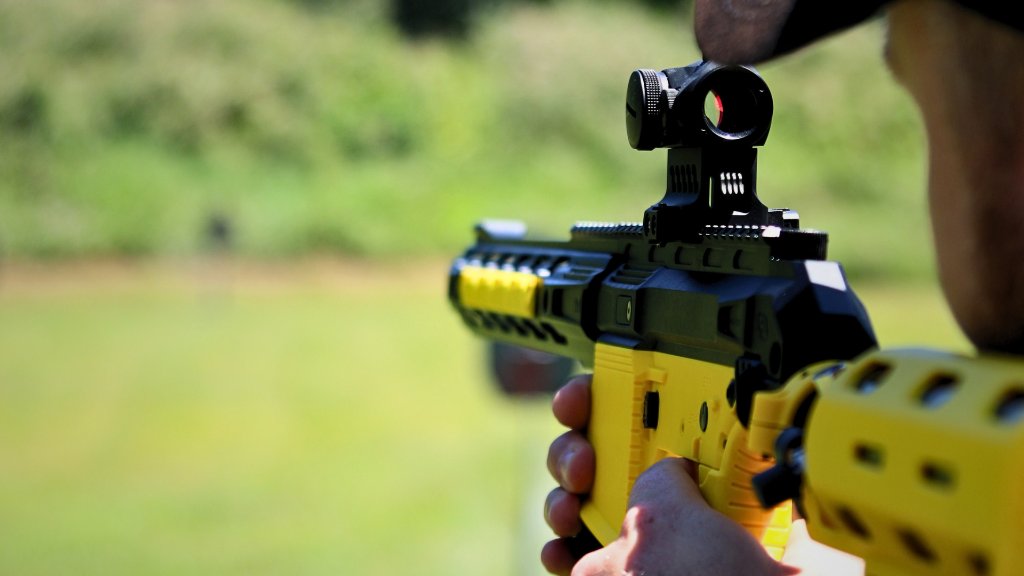
The City of Aberdeen, South Dakota, recently authorized a formal application for FY2026 Edward Byrne Memorial Justice Assistance Grant funds specifically to support a transition from shotgun-launched impact munitions to rifled 40mm launcher platforms. The grant allocation amounts to approximately $21,000, and according to the authorization, that sum will be divided equally between the Aberdeen city police department and Brown County. The split-funding arrangement reflects how smaller jurisdictions are structuring these acquisitions—sharing both the financial burden and the operational benefit across municipal and county lines.
The JAG program is not the only federal mechanism in play. Agencies have also begun drawing on the FY2026 Homeland Security Grant Program to fund less-lethal technology upgrades, and legislative changes enacted in 2026 have removed certain less-lethal projectile devices from excise tax and National Firearms Act requirements. That regulatory shift directly lowers the per-unit acquisition cost for municipal buyers who previously faced tax markups on NFA-classified items. Together, the grant availability and the tax change have compressed the financial barriers that historically slowed these procurement decisions.
What California Agencies Are Already Paying
Two California departments completed 40mm transitions ahead of the current procurement wave and have documented their costs in detail. The Alhambra Police Department integrated new single-launcher units into its inventory at $1,145 per unit. The department pegs the expected service life of each launcher and associated munitions at five years, giving budget planners a straightforward amortization figure to work from.
Los Altos Police Department took a different procurement path, acquiring Penn Arms single-launcher units at $1,000 each. Los Altos replaced its existing less-lethal shotgun inventory with the new platforms. The department reported an annual maintenance cost of approximately $100 per launcher—a figure that, when stacked against the five-year lifespan benchmark Alhambra cited, suggests a total cost of ownership in the range of $1,500 to $1,650 per unit over that period, depending on which purchase price applies.
On the munitions side, the Defense Technology Exact Impact 40mm sponge round is a common standard across agencies making this transition. Per-unit cost runs approximately $25 to $29. These rounds are point-of-aim, point-of-impact direct-fire projectiles, meaning the accuracy profile differs substantially from older shotgun-launched munitions that do not offer the same targeting precision at extended range.
Why Agencies Are Moving to Rifled 40mm Platforms
The operational rationale is straightforward. Rifled 40mm launchers extend effective range, improve accuracy, and increase standoff distance for deploying officers compared to shotgun-launched alternatives. Those three factors bear directly on officer safety and on the legal defensibility of a deployment, since use-of-force policies at most agencies require that officers use the minimum force necessary and maintain reasonable positioning relative to a subject.
Agency policies governing 40mm deployments require adherence to state and federal legal standards. Personnel must be trained and certified by POST-certified instructors before they are authorized to carry or deploy 40mm control devices, according to standard policy frameworks in use at agencies that have completed the transition. That certification requirement adds a training cost and timeline that agencies must account for alongside hardware procurement.
The Department of Homeland Security has also run a significant procurement surge for specialty munitions, which has contributed to broader market movement toward 40mm systems. When a federal buyer of that scale accelerates purchasing in a product category, it tends to pull along municipal buyers who benefit from the resulting standardization of platforms, training curricula, and supply chains.
Procurement Timelines and What Agencies Should Expect
Industry patterns show that procurement cycles for these less-lethal platforms typically span 12 to 24 months. The delay is not primarily logistical. It reflects the time agencies spend on liability review, policy drafting, legal counsel sign-off, and officer training certification before a new use-of-force tool reaches the field. Agencies that begin the JAG or HSGP application process now should factor that 12-to-24-month window into deployment timelines.
Aberdeen's move to formalize a grant application before completing procurement is consistent with how well-managed transitions unfold. Securing funding authorization early leaves room to complete the policy and training review without financial pressure forcing a compressed timeline. The equal split with Brown County also suggests a coordinated regional approach—both agencies presumably will standardize on the same platform, which simplifies cross-jurisdictional training and mutual aid scenarios.
For agencies currently evaluating the transition, the Alhambra and Los Altos cost data provides a working budget floor. A unit acquisition cost between $1,000 and $1,145, annual maintenance near $100, munitions at roughly $25 to $29 per round, and a five-year service life are the key variables. Grant funding in the $21,000 range, as Aberdeen secured, can cover initial hardware for a department of modest size while the policy and certification process runs its course.